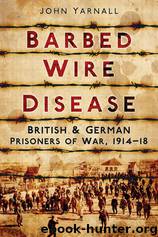
Barbed Wire Disease: British & German Prisoners of War, 1914-1918 by John Yarnall
Author:John Yarnall [Yarnall, John]
Language: eng
Format: epub
Tags: Captivity, World War I
Goodreads: 10629103
Publisher: Spellmount
Published: 2011-06-17T08:00:00+00:00
9
DAILY LIFE IN GERMANY
By 1916, administration of the POW camps had largely settled down. Inevitably, a great number of existing sites and buildings had had to be used to house the large number of prisoners taken, as well as new camps specifically constructed for the purpose. In Germany, camps were established in hotels, forts, schools, country houses and traditional barracks. The officers’ camp at Schweidnitz, comprising brick barracks sited in a garden of about an acre, had a pedigree dating back to 1870, when it had then been used as a place of internment in the Franco-Prussian War. The officers’ camp at Fürstenberg, 50 miles north of Berlin, was based at a well-known summer hotel or convalescent home, Erholungsheim, a mile from the town. The hotel offered a good view over the surrounding country and lake, a veranda and considerable grounds. Old castles and forts were popular locations for camps. Celle Schloss, a castle formerly belonging to the King of Hanover, was used to house civilian and ex-officer prisoners; Rosenberg fortress, situated on a hill above the town of Kronach, housed officer prisoners in two wings of the high citadel; and at Beeskow, officers were housed in the old castle of the local bishop, built in the sixteenth century. At Blankenberg, officers were interned in three-storied houses previously comprising ‘a home for gentlewomen’.
For NCOs and other ranks, much larger camps were generally needed. As the war progressed, so did the size of the camps. The capacity of the average camp grew to between 10,000 and 12,000 men, though many were even larger. Schneidermuhl had the capacity for 40,000 to 50,000 prisoners. Friedrichsfeld, 60 miles north of Cologne, eventually had the capacity for 35,000 prisoners. This camp comprised barracks with open space in the centre for football and tennis, gardens and flowerbeds between the barracks, and large vegetable and potato fields run by the prisoners. Brandenburg Camp consisted of an abandoned terracotta factory. And particularly unusually, at Danzig the prisoners were housed in barges four deep and four long, moored to a flat stretch of land on the bank of the Vistula. Some of the barges contained between 100 and 500 men, with their holds being lit by electricity. All the administrative and support facilities for the camp, including kitchen, store house and YMCA hut, were located on land. Güstrow Camp, near Mecklenburg, held some 25,000 men in wooden barracks situated in pine woods, while not far away at Parchim Camp, another 25,000 men were held in barracks built on a former cavalry drill ground.
In a number of cases, towns or localities became the home for a cluster of camps. At Senne, the camp of Sennelager actually comprised three camps: Senne I, II and III. Whilst Münster Camp comprised camps I to IV. Camp I was located some distance from the city in open country; Camp II was situated on the racecourse – and hence became known as Rennbahn – the grandstand providing space for offices, a chapel and a theatre;
Download
This site does not store any files on its server. We only index and link to content provided by other sites. Please contact the content providers to delete copyright contents if any and email us, we'll remove relevant links or contents immediately.
| Africa | Americas |
| Arctic & Antarctica | Asia |
| Australia & Oceania | Europe |
| Middle East | Russia |
| United States | World |
| Ancient Civilizations | Military |
| Historical Study & Educational Resources |
Room 212 by Kate Stewart(5119)
The Crown by Robert Lacey(4814)
Endurance: Shackleton's Incredible Voyage by Alfred Lansing(4780)
The Iron Duke by The Iron Duke(4354)
The Rape of Nanking by Iris Chang(4211)
Joan of Arc by Mary Gordon(4109)
Killing England by Bill O'Reilly(4001)
Say Nothing by Patrick Radden Keefe(3984)
I'll Give You the Sun by Jandy Nelson(3447)
Shadow of Night by Deborah Harkness(3367)
Hitler's Monsters by Eric Kurlander(3342)
Mary, Queen of Scots, and the Murder of Lord Darnley by Alison Weir(3210)
Blood and Sand by Alex Von Tunzelmann(3203)
Eleanor & Park by Rainbow Rowell(3172)
Darkest Hour by Anthony McCarten(3130)
Margaret Thatcher: The Autobiography by Thatcher Margaret(3082)
Book of Life by Deborah Harkness(2938)
Red Famine: Stalin's War on Ukraine by Anne Applebaum(2933)
The One Memory of Flora Banks by Emily Barr(2863)
